History
Six decades on Pickerel Lake.
The association has a longer story than most people realize. It started before the interstate was finished, before the county had paved half its roads, and before anyone on the lake had heard the phrase aquatic invasive species. Here is the short version, drawn from newsletters, bylaws, and the memories of members who have been on the water since before the club was organized.
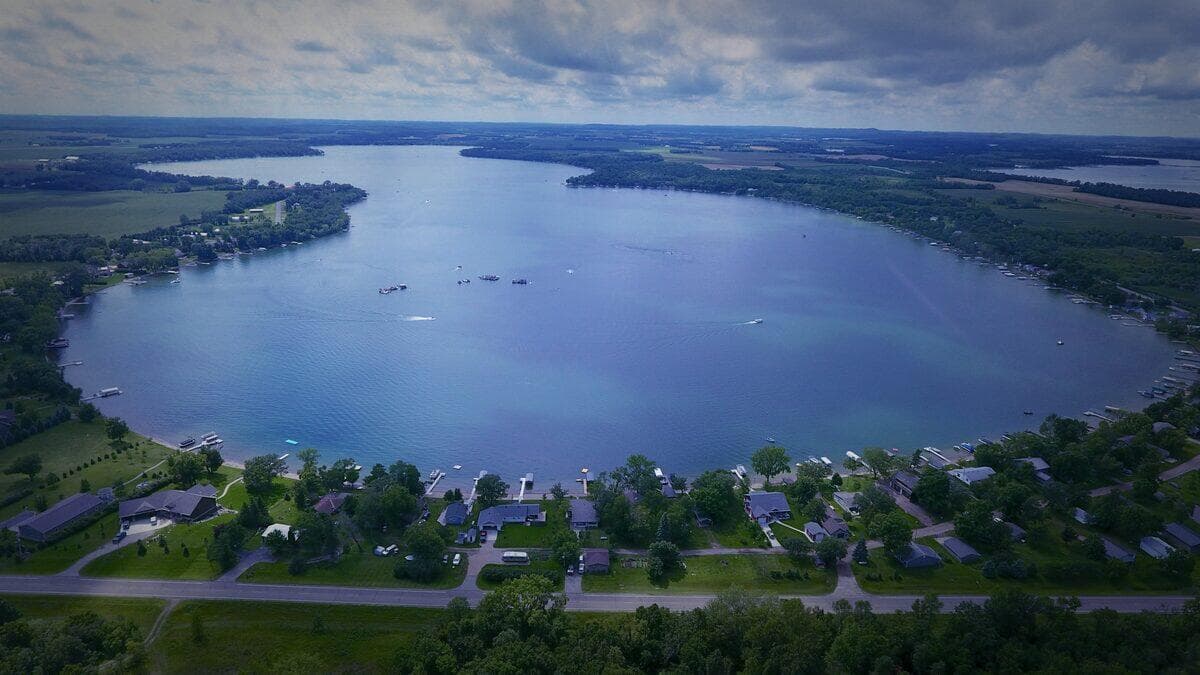
Pickerel Lake from above — 829 acres, 78 feet at its deepest point, wrapped by the cabins and resorts of six generations.
1880s
John G. Haggstrom settles in Maine Township.
A Swedish immigrant who had spent fourteen years in the stone quarries of Lockport, Illinois, John G. Haggstrom arrives in Otter Tail County in December of 1882 and buys forty acres in the town of Maine. He adds to his farm steadily — thirty-two more acres in 1884, twenty-seven in 1887, twenty-seven again in 1900, another forty in 1907. The Haggstrom family becomes the first substantial landowners along the shore of Pickerel Lake. The development of the lake, a half-century later, will start on land they bought.
Family history adapted from Mason History records via Tom O'Brien.
Mid 1940s
Haggstrom's Resort opens on the east shore.
Four cabins on the east side of Pickerel Lake, owned and run by Conrad and Tillie Haggstrom (Conrad is John G. Haggstrom's son), become the first organized resort on the water. Shoreline lots sell for $300–$500 for 60 feet of frontage. Families come up from Fargo and the Twin Cities for the walleye and the quiet. Cabins follow, most of them modest places built by hand with rough sawn lumber.
Early 1950s
Shady Nook opens on the west shore.
Adolph and Ethel Haggstrom — Conrad's brother — develop a second resort on the west side of the lake: nine cabins, known as Shady Nook. Pickerel is no longer just an east-shore lake. It is a full-circle community with two resorts, both still in the Haggstrom family, on opposite shores.
Early 1960s
The Pickerel Lake Club is organized.
A group of cabin owners forms the Pickerel Lake Club with 64 paid memberships. The club's original purpose is modest — coordinate seasonal concerns between neighbors, share the cost of a few shoreline projects, and publish a directory so people who only know each other by boat can reach each other by phone. Over the following years, the lake is stocked with walleye and northern pike by the MN DNR. The club is later renamed the Pickerel Lake Improvement Association.
1970s
Membership grows; the weir goes in.
Shoreline lots now sell for $10,000. Membership in the association climbs to a peak of 161 households. A weir is installed to steady lake levels across drought and flood years — one of the association's first durable infrastructure projects. Local rules take shape: lake homes must sit 100 feet back from the shoreline, every property is assigned a fire number, and the first annual Pickerel Lake Directory is printed.
1980s
Water quality, sewer, and the boat parade.
Excellent water-quality reports come back year after year. More stocking of walleye and northern pike. Dutch elm disease takes out shade trees across the township. The township begins requiring permits for new construction and for sewer systems on the lake. Community garbage-collection racks go in. The July 4th Boat Parade is formalized — the first year requires a permit. And in 1980, a volunteer begins keeping a ledger of ice-out and ice-in dates. That ledger, still being kept, will eventually span forty-six seasons.
1990s
Lakeshore prices climb; tent caterpillars arrive.
A 150-foot lot sells for $300,000. The lake is fully built-up. Tent caterpillar infestations require aerial spraying for the first time, and the Spray Donation Escrow fund is established so the association can pay for treatment without a special assessment. High water levels force property owners along several bays to rip-rap their shorelines to prevent erosion.
2000s
Preservation becomes the mission.
The association's stated goal — preserving and protecting Pickerel Lake — becomes the organizing principle for a generation of new projects: shoreline restoration, sewer-system inspections, algae monitoring, and cooperation with UMN Extension and RMB Labs on water testing.
July 2024
Zebra mussels are confirmed.
On July 11, 2024, an adult zebra mussel a half-inch long is found attached to a clam in the east bay. A follow-up DNR dive on July 16 finds a second adult mussel in the same bay. The Minnesota DNR designates Pickerel Lake an infested water. The association pivots its work: prevention of spread to other lakes, boat-inspection awareness, landing-side signage, and MN Statute 84D.09 compliance become the top of every meeting agenda.
2026
Twelve volunteers, one lake.
The board consists of twelve members elected to three-year terms at the annual meeting, per the PLIA bylaws. Water quality is tested in partnership with RMB Labs, the Minnesota Pollution Control Agency, and UMN Extension. The Spray Donation Escrow funds tent-worm response. Adopt-A-Highway crews clean Highway 74 from Amor to St. James Catholic Church twice a year. And every July, neighbors still gather at a member's home for a potluck and live music.
A small tradition
The Pickerel Lake Directory.
Since the 1970s, the association has compiled and distributed an annual Pickerel Lake Directory — a printed booklet with every member household's name, phone, and address on the lake. It is, in effect, the original social network of the water.
Most lakes do not have one. The directory is how new cabin owners meet their neighbors without waiting for the Fourth of July, how boat-parade routes get organized the week before, and how the board reaches people in a storm. It remains a paper artifact on purpose; the digital version of the association has never been a replacement for it.
Sources
- PLIA 2026 annual newsletter (current dates, board roster, calendar)
- PLIA bylaws, Article 1 § 1 (board composition and terms, ratified June 2010)
- PLIA Jigsy archive history page, compiled by Tom O'Brien: pickerellakeimprovementassociation.jigsy.com/history-of-pickerel-lake
- PLIA Board of Directors zebra-mussel announcement (July 2024), published on the Jigsy site
- Mason History records (Haggstrom family genealogy)
- Minnesota DNR LakeFinder and MN PCA surface-water records
- Otter Tail County waters classification list
Corrections welcome. Email board@pickerellakemn.org with anything a member remembers differently — the point of this page is to get the story right.